“Their mindset has changed. They are hopeful, and they know that education is the key to success.”
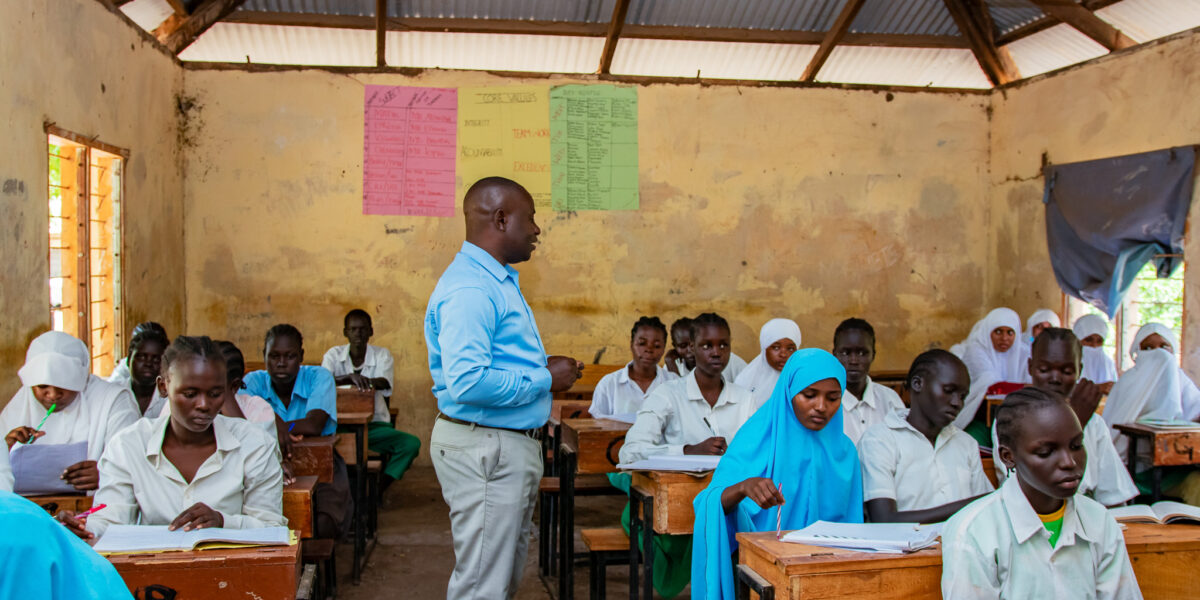
For Mr. Justine Maloba, a teacher at Greenlight Secondary School in Kakuma Refugee Camp (Kenya), education is more than a profession, it is a daily commitment to young people whose lives have been shaped by displacement and uncertainty.
For the past seven years, he has walked the dusty paths of the camp to reach his classroom, accompanying students who carry the weight of poverty, instability and limited opportunities. Yet over time, he has also witnessed something powerful: how education can begin to transform the way students see themselves and their future.
The challenges schools face
Teaching in a refugee camp also means working within many limitations that shape the daily life of schools. In Kakuma, both students and teachers navigate conditions marked by displacement, scarce resources and uncertainty about the future.
Many students struggle to remain in school because they lack basic necessities such as uniforms, school fees or sanitary pads. These barriers often lead to missed classes, falling behind in lessons and, in some cases, dropping out altogether.
For Mr. Maloba, one of the hardest parts of teaching has been watching bright and capable students lose their path simply because the conditions around them make learning difficult.
Strengthening education in the school
In this context, the work carried out by the Jesuit Refugee Service (JRS) and Entreculturas, with the support of ECHO, has helped address some of the barriers that often interrupt education in refugee settings.
Mr. Maloba has seen these changes directly in his daily work as a teacher.
Support for teachers has played an important role in strengthening the quality of education. Training opportunities have helped educators adapt to the curriculum and improve their teaching practices, allowing them to better support students in the classroom.
At the same time, improvements in school infrastructure have helped create better conditions for learning. More adequate classrooms and facilities have made schools more suitable environments for both teaching and learning.
The school has also strengthened its relationship with families and the wider community. By working more closely with parents and conducting home visits when needed, teachers are better able to understand the challenges students face outside the classroom and support those at risk of dropping out, helping more learners remain in school.
Education as a space of protection
As the school environment has strengthened, Mr. Maloba has also witnessed a transformation in the way students experience their access to education.
With better learning conditions, stronger support from teachers and closer engagement with families, the school has become a place where students feel encouraged to stay, participate and believe in their potential. Initiatives such as gender clubs have also helped promote respect and cooperation among students, encouraging boys to support girls’ education and contributing to a more inclusive atmosphere in the school.
For Mr. Maloba, these changes are visible every day in his classroom. More students now attend school regularly, and girls who once faced the greatest barriers are more present in class. Students who once hesitated to participate now raise their hands with confidence and speak more openly about their dreams. For many of them, education is no longer just about attending classes, it is a pathway to imagine and pursue a different future.
Supporting education for refugee learners
In displacement contexts like Kakuma refugee camp, secondary education offers more than academic knowledge. It provides structure, identity and possibilities. For refugee learners, completing secondary school can open doors to scholarships, further education and opportunities beyond the camp. Without it, their options shrink dramatically.
For Mr. Maloba, witnessing these changes is what keeps him motivated. Every morning, as he walks through the school gate, he sees resilience and determination in his students.
Through their work in Kakuma and Dadaab refugee camps, JRS and Entreculturas, with the support of ECHO, continue working to strengthen schools so that young people like his students can keep learning, imagining their future and building new opportunities.
Explore more