“Education is important to me because it prepares girls to speak up. I want to advocate for girls and challenge stereotypes. I want to show my community that girls are not just meant for marriage.”
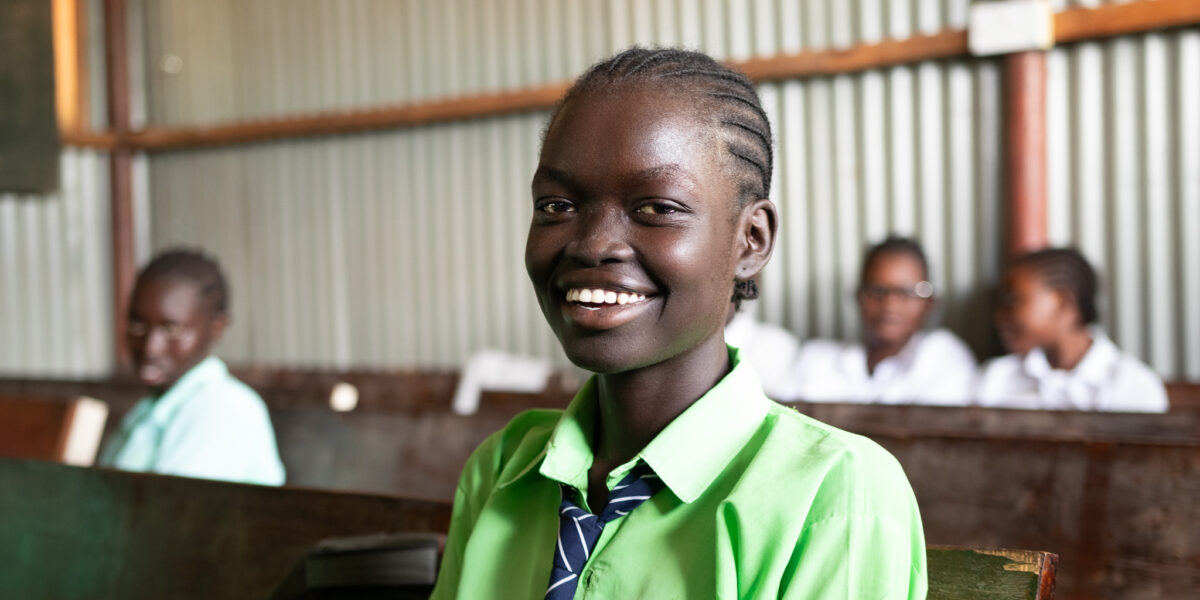
For Nyadak John Suleiman, a South Sudanese refugee student studying at Vision Secondary School in Kakuma refugee camp in Kenya, education is no longer just about attending classes. It is about imagining a different future, one where she can build a career and speak up for other girls in her community. Today, she dreams of becoming an accountant. But seeing that future was not always easy.
The structural barriers girls face
Growing up in a refugee camp, Nyadak faced many of the barriers that affect girls in her community. Deeply rooted social norms often limit their opportunities to continue their education.
For girls between the ages of 10 and 17, early marriage and teenage pregnancy remain among the main reasons many leave school. At home, gender roles also shape daily life: “At home, girls do everything while boys sit and do nothing,” she recalls.
Menstrual hygiene is another challenge for many girls in the refugee camps. Without access to sanitary pads, many miss classes during their period and fall behind in their studies — something Nyadak experienced herself.
Education: a safe space
In this context, where many girls face barriers that limit their education, schools can become spaces of protection and opportunity, places where students feel supported and encouraged to imagine different futures. For Nyadak, this is exactly what school has become. “School is a safe space for me,” she explains. “Here, boys and girls are treated equally. I don’t feel the discrimination I feel at home.”
Being part of this environment has also changed the way Nyadak sees herself and her future. “Education has opened my mind,” she says. “I now see a future where girls’ voices matter.”
For Nyadak, education is no longer only about attending classes. It is about discovering her voice, imagining new possibilities and believing that her future can look different from what she once expected.
A safe space to grow
Within this environment, Nyadak began to discover her own aspirations and imagine a future for herself. Over time, she found a passion that surprised even her: she now dreams of becoming an accountant. One of her teachers, Vanessa, played an important role in that journey, encouraging her not to give up on mathematics — a subject she once believed she was not meant to understand.
“Mentorship opened my mind,” Nyadak says. “Even though I was not good at math at first, I learned that I could improve.”
School activities, including music festivals and other events, also helped Nyadak gain confidence and feel part of the school community. At the same time, practical support removed some of the barriers that once made attending school difficult. Access to sanitary pads meant she no longer had to miss classes during her period.
“I stopped missing school because of my period. I was able to attend every day, and that alone motivated me to try harder,” she explains.
With growing confidence and a clear dream ahead of her, Nyadak now imagines possibilities she once struggled to see. “My future is bright now,” she says. “And this time, the dream is mine.”
Supporting safe education in refugee camps
Nyadak’s story reflects the importance of ensuring that schools in refugee contexts remain spaces of protection, learning and opportunity, especially for girls who face multiple barriers to continue their education.
Through our work in Kakuma and Dadaab refugee camps, the Jesuit Refugee Service (JRS) and Entreculturas support schools so that children and young people can continue learning in a safe and inclusive environment. With the support of ECHO, this work helps address some of the challenges that often interrupt education, from gender-based discrimination to barriers such as menstrual hygiene.
By strengthening school communities and supporting students to stay in school, these efforts help young people like Nyadak build confidence, pursue their aspirations and imagine a different future.
Explore more