Education & Psychosocial Well-being: JRS at the heart of the dissemination of the TeamUp approach in Burundi
15 October 2026
Jesuit Refugee Service (JRS) is playing a central role in disseminating the results of a major scientific study on the well-being of displaced children, anchoring the TeamUp approach in Burundi’s communities and institutions.
A proven approach, results to be shared
 TeamUp is a group-based psychosocial intervention based on movement: sports, games, dances, songs and breathing exercises for children aged 6 to 17. Developed and scientifically evaluated by War Child Alliance, this approach was the subject of a rigorous study conducted between 2023 and 2024 in the former commune of Nyanza-Lac, in the former province of Makamba.
 After two years of implementation in 36 schools, the results are clear: TeamUp significantly improves the psychosocial well-being and resilience of children affected by conflict and violence. It was now essential to share them widely and sustainably.
JRS was asked as a trusted partner to co-organize the dissemination activities, a direct recognition of its field roots, its institutional network and its expertise in the educational support of displaced populations in Burundi.
What JRS has brought to the field
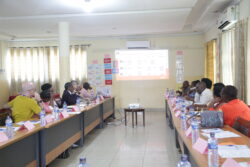 In collaboration with the War Child Alliance, JRS contributed to the organization and conduct of five major dissemination moments in May 2026, reaching very different audiences:
- A workshop with national and international NGOs to mobilize concrete commitments to integrate TeamUp into their programs.
- A formal meeting with UN Ministries and agencies for institutional sharing of results and advocacy for scale-up.
- A meeting with directors of partner schools in Nyanza, to define their role in the continuity of the approach.
- A day of training and closing with community facilitators, equipped to report the results to children, parents and teachers.
- Direct dissemination in schools to children, their parents and teachers in the 36 schools in the Makamba and Nyanza areas.
The dissemination activity fully achieved its objective of sharing the results of the TeamUp research with all stakeholders. A total of 2630 people were directly affected:
- 11 administrative and ministerial executives.
- 12 NGO representatives.
- 14 research assistants.
- 32 directors, 1 representative of the DPE, DCE and municipal administrator of Nyanza.
- 39 TeamUp facilitators.
- 2198 children in the 6th and 4th grades.
- 65 teachers.
- 256 parents.
This process, carried out through 5 strategic meetings and community feedback in 36 schools, allowed for collective ownership of the research results at all levels.
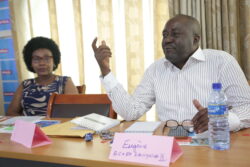 The presentation of the results elicited very positive reactions from the representatives of participating NGOs. Several representatives welcomed the concrete, participatory and context-specific nature of the TeamUp approach, stressing its effectiveness in improving the psychosocial well-being of children. Some partners have expressed interest in integrating this approach into their future programmes, subject to the availability of funding.
Discussions with ministerial and administrative representatives highlighted a strong adherence to the values carried by the TeamUp approach. Some expressed interest in facilitating advocacy with technical and financial partners for scaling up this approach.
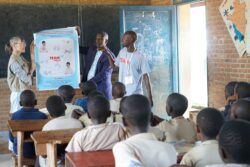 For two days, the pairs of facilitators visited the 36 schools of the project to share the results of the research in a simplified form with children, parents and teachers. In each school, two separate 30-minute sessions were held: one with the children of the targeted classes with their teachers and another with the parents.
A dedicated meeting between the War Child Alliance and JRS teams also made it possible to align strategies and prepare for the continuation of the partnership.
Why it matters to JRS
JRS’s mission is to accompany, serve and defend the rights of refugees and displaced people. With this in mind, supporting the dissemination of TeamUp is not a symbolic gesture: it is a concrete commitment to ensure that scientifically validated methods continue to benefit the most vulnerable children, well beyond the duration of a project.
By ensuring that community facilitators have the tools to convey these findings to families and teachers, JRS is contributing to lasting change that is community-led change.
Explore more